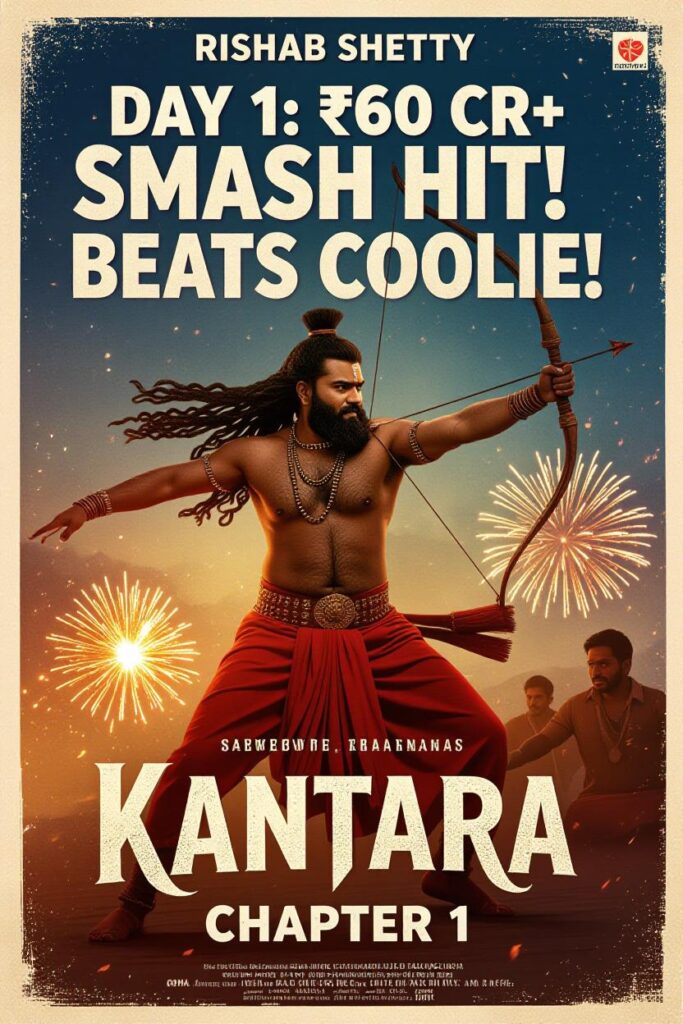
Rishab Shetty’s Kantara: A Legend Chapter 1 has become the talk of the town, and honestly, the box office numbers speak volumes about why this film is breaking records left and right! By day 7, this Kannada masterpiece has crossed the mammoth ₹450 crore mark worldwide, and I’ve got to say, watching this prequel outperform biggies like Brahmastra and the iconic 3 Idiots has been nothing short of exhilarating for cinema lovers across India. Let me break down what’s happening here because this isn’t just another box office success story – this is a cultural phenomenon that’s rewriting the rules of Indian cinema. The film collected approximately ₹300 crore in domestic markets by the end of its first week, with overseas collections pushing the worldwide total past ₹450 crore, and some reports even suggesting it’s inching closer to ₹500 crore! What makes this achievement even more remarkable is that Kantara Chapter 1 is a Kannada film that’s performing exceptionally well across all language markets – the Hindi version alone crossed double digits on day 6, which is unprecedented for a regional film. The original Kantara, which released in 2022, was already a sleeper hit that caught everyone by surprise with its unique storytelling rooted in coastal Karnataka’s folklore and traditions, but this prequel has taken things to an entirely different level right from its opening day. With a reported opening of around ₹60 crore across all languages on day 1, Kantara Chapter 1 secured the third biggest opening of 2025, trailing only behind Coolie and Saiyaara, which itself is a massive achievement considering it’s competing against big-budget Bollywood and pan-India releases. What’s fascinating about this film’s journey is how it’s managed to maintain strong momentum throughout its first week despite the usual weekday drops that most films experience – the word-of-mouth has been phenomenal, with audiences praising Rishab Shetty’s direction, performance, and the film’s stunning visuals that bring the ancient legend to life. The film stars Rishab Shetty himself in the lead role, along with Jayaram, Rukmini Vasanth, and Gulshan Devaiah, and the ensemble cast has delivered performances that critics and audiences alike are raving about. Trade analysts are now watching closely to see if Kantara Chapter 1 can maintain this blistering pace through its second weekend, and there’s genuine speculation about whether it could eventually aim for the elusive ₹1000 crore club – a milestone that only a handful of Indian films like Baahubali 2, KGF Chapter 2, RRR, and Jawan have achieved.
Speaking of KGF Chapter 2, Kantara Chapter 1 has now become the second highest-grossing Kannada film of all time, trailing only behind KGF Chapter 2’s massive ₹1,250 crore worldwide collection, which is a testament to how Kannada cinema is emerging as a major force in Indian entertainment. The fact that this film has beaten established blockbusters like Brahmastra (which had a massive budget and star power of Ranbir Kapoor and Alia Bhatt) and the all-time classic 3 Idiots (which has been a benchmark for Hindi cinema collections for years) shows that audiences today are more interested in compelling stories and authentic filmmaking rather than just big names and expensive productions. The film’s success is also a victory for regional cinema and proves that language is no longer a barrier when it comes to great storytelling – people across India are flocking to theaters to watch this Kannada film in its original language or dubbed versions because the story, emotions, and cultural richness transcend linguistic boundaries. What’s working in Kantara Chapter 1’s favor is its unique positioning as a prequel that explores the origins of the deity Panjurli and the ancient traditions shown in the first film, giving audiences a deeper understanding of the mythology and folklore that made the original so captivating. The film’s production values are top-notch, with stunning cinematography capturing the lush forests and coastal landscapes of Karnataka, and the action sequences choreographed by Rishab Shetty himself are being hailed as some of the best in recent Indian cinema.
The music and background score also play a crucial role in creating the mystical atmosphere that the film requires, and audiences are connecting with the spiritual and cultural elements woven throughout the narrative. Social media has been buzzing with discussions about specific scenes, performances, and the film’s climax, which people are calling goosebump-inducing, and this organic buzz is translating into consistent footfalls even on weekdays when most films see significant drops. The exhibitors and theater owners are thrilled because Kantara Chapter 1 is bringing audiences back to cinemas during a period when many were worried about declining theatrical attendance, and the film is performing well across single screens, multiplexes, and even in tier-2 and tier-3 cities where regional content typically resonates strongly. Looking at the competition, films like Sunny Sanskari Ki Tulsi Kumari, They Call Him OG, and Jolly LLB 3 are struggling to make an impact because Kantara Chapter 1 is dominating screen counts and audience mindshare, which shows that when a film truly connects with people, nothing can stop its box office juggernaut.
The international markets are also contributing significantly to the film’s collections, with strong performances in the Middle East, North America, and other regions where the Indian diaspora is present, proving that Indian cinema’s global appeal continues to grow. Trade experts believe that if the film maintains even 60-70% of its first week collections in the second week, it could comfortably cross ₹600-700 crore worldwide, and a lifetime total of ₹800-900 crore seems achievable if the momentum sustains. What I find most exciting about Kantara Chapter 1’s success is what it means for the future of Indian cinema – it’s encouraging more filmmakers to take risks with regional stories, authentic cultural narratives, and content-driven cinema rather than relying solely on star power and formulaic plots, and this shift is ultimately beneficial for audiences who get more diverse and engaging content to consume.
Rishab Shetty, who wrote, directed, and acted in the film, has proven himself to be a true auteur who understands both the commercial and artistic aspects of filmmaking, and his dedication to preserving and showcasing Karnataka’s rich cultural heritage through cinema deserves all the appreciation it’s receiving. As we move into the second week, all eyes will be on whether Kantara Chapter 1 can hold strong against new releases and continue its record-breaking run, but given the phenomenal response so far, I’d say the film is well on its way to cementing its place as one of the biggest blockbusters in Indian cinema history!